
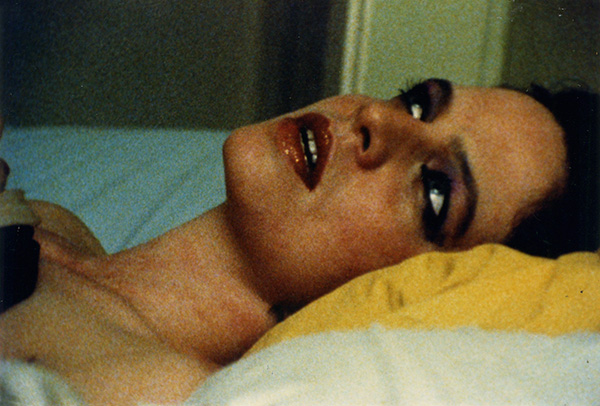
Tinka Menkes plays “Ida” in MAGDALENA VIRAGA
August 4, 2025
Exciting that Professor Sylwia Frach has published her article on MAGDALENA VIRAGA and the “Intersectional Gaze”!
Abstract below:
ABSTRACT
This article contributes to feminist film theory by introducing the concept of the ’intersectional gaze. Building on Laura Mulvey’s triad of cinematic looks—the camera, the audience, and the characters—it proposes three interrelated perspectives: the ’fractured lens,‘ ’reflexive visions,‘ and ’embodied perspectives.‘ Rather than simply inverting Mulvey’s male gaze theory, the ’intersectional gaze‘ highlights cinema’s capacity to reveal and interrogate marginalized identities and their experiences. A close reading of Nina Menkes’s Magdalena Viraga: Story of A Red Sea Crossing (1986), a film influenced by Gertrude Stein’s novel Ida, demonstrates how the film critiques patriarchal visual conventions and foregrounds intersectional oppressions. Drawing on Kimberlé Crenshaw’s theory of intersectionality, Gilles Deleuze and Félix Guattari’s concepts of ’desiring-production,‘the ’body without organs,‘ and ’deterritorialization’ ,as well as Jacques Lacan’s notion of the uncanny, the analysis shows how Menkes disrupts dominant cinematic forms. The film emerges as a site of resistance, positioning the ’intersectional gaze’ as a critical strategy forchallenging hegemonic cinematic language and centering marginalized subjectivities. This study ultimately affirms the role of feminist cinema in dismantling oppressive systems and imagining more inclusive modes of representation.
Professor Sylwia Frach
Kopernika 11a, Opole 45-040, Poland.
WOMEN’S STUDIES
https://doi.org/10.1080/00497878.2025.2533170
© 2025 The Author(s). Published with license by Taylor & Francis Group, LLC.